The Manufacturer has been a prominent industry publication for more than 30 years, covering manufacturing news, leadership insights and best practice across the industrial sector. As technology continues to advance and transform the industrial landscape, The Manufacturer is at the forefront of this change, working with innovative manufacturers and technology providers to share insights with its community.
UKFT contributed to the Q3 2026 issue, which launched on Monday 17 August, alongside UKFT members Arville, Toray Textiles and Carrington Textiles.
In the article, James Devonshire, News Editor at The Manufacturer, explores how British textiles extend far beyond fashion, heritage mills and traditional craftsmanship, with technical textile manufacturers establishing themselves as world leaders in advanced materials.
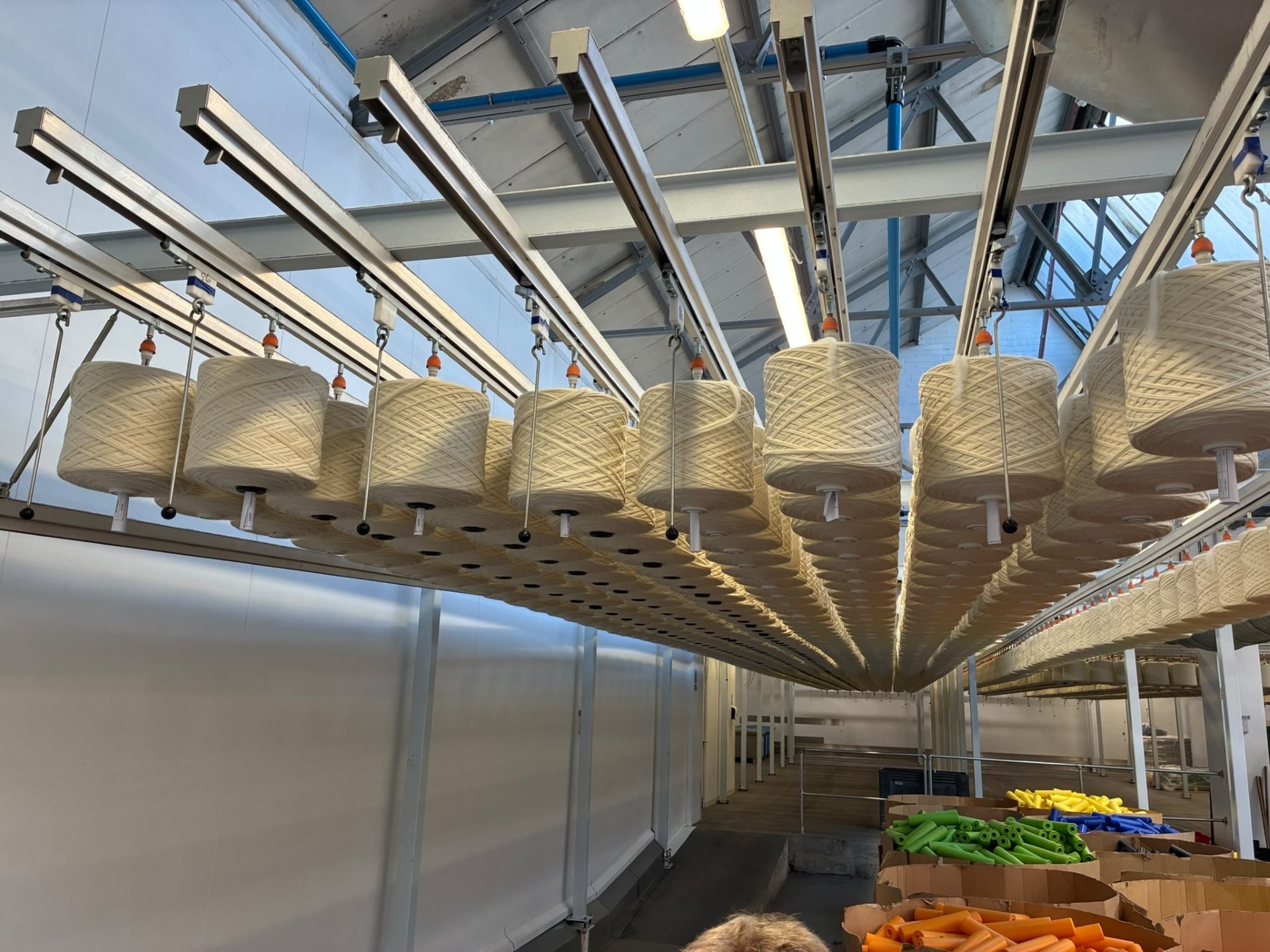
Across the country, manufacturers, material specialists, machinery developers and testing laboratories contribute to a highly diverse ecosystem supporting industries ranging from aerospace and defence to healthcare, construction, filtration, automotive and advanced composites. Technical textiles in the UK extend far beyond conventional fabrics, encompassing engineered materials, specialised fibres, precision components, coatings, membranes and advanced processing technologies.
In The Manufacturer article, Adam Mansell, CEO of UKFT, said: “Technical textiles are unseen because predominantly the actual material itself is unseen. But they feature in pretty much every part of our lives.”
The UK’s technical textiles industry was valued at £3.6bn in 2024 and is projected to grow to £5.3bn within a decade. There are between 750 and 1,000 technical textile companies operating in the UK. Additionally, as part of UKFT’s Discover British Textiles campaign, UKFT also accompanied more than 45 UK companies to Techtextil and Texprocess in Frankfurt in April 2026.
Tara Hounslea, Director of Communications at UKFT, added: “When people hear ‘textiles’, they often think it’s just clothes. But actually, technical textiles are tackling big global challenges. They’re performing structural necessities and life-saving operations, but because they’re not visible products, people simply don’t know they’re there.”
Paul Daynes, Sales Manager at Toray Textiles, went on to highlight that lightweight fashion textiles now make up 10% of the company’s sales volume, compared with 100% 25 years ago. That side of the business has since migrated to Asia.
The article then speaks to Paul Farrell, Director of Sales and Marketing at Carrington Textiles, about military fabrics that go beyond conventional camouflage.
“Modern military fabrics actually incorporate highly specialised performance characteristics that include elements such as infrared reflective properties to help conceal personnel from surveillance, drone technology and surveillance technology that’s built into the textile.”
The article goes on to discuss how UK-purchased defence textiles are increasingly not manufactured in the UK. Steve Gill, CEO of Arville, highlights that technical textiles are increasingly incorporating embedded electronics and nanotechnology for defence applications, and that sourcing these products overseas presents a security risk.
“We should be looking to do that ourselves and keep it here.”
The article also explains how the relationship between technical textile manufacturers and their customers is changing. As a result, manufacturers are increasingly being asked to solve engineering problems rather than simply produce materials to a specification.
“It’s no longer a salesman talking to a buyer. Customers are now seeking a multi-level partnership” Steve says.
Another issue facing UK technical textiles is skills and the age of the workforce. In recent years, both Arville and Carrington Textiles have struggled with an ageing workforce and with bringing younger people into the sector, who may have a better understanding of the technical aspects of the industry.
Arville has introduced a placement scheme launching this year, in which five students will rotate through R&D, the lab, manufacturing and marketing over 12 months.
As the government-appointed Sector Skills Body, UKFT oversees apprenticeships across the fashion and textile sector, and works closely with industry to develop and support training opportunities. Learn more about what UKFT do to support skills and training here.
The article goes on to discuss the pressures facing UK technical textile manufacturers, with their cost base difficult to compare directly with manufacturers in Asia or Latin America operating under different conditions.
Katie Robinson, Textile Membership Manager at UKFT, said: “We aren’t going to compete with the Far East on price, and we don’t need to. But we can create new technologies, better and more productive ways of working, and the next generations of product.”
Despite the challenges of procurement policies, an ageing workforce and financial pressures, the article concludes that the industry remains optimistic about the future of the sector.
“Textiles is not an industry of the past; it’s an industry of the future,” said Paul from Carrington Textiles. “Really technical textiles is where material science, manufacturing and innovation intersect.”