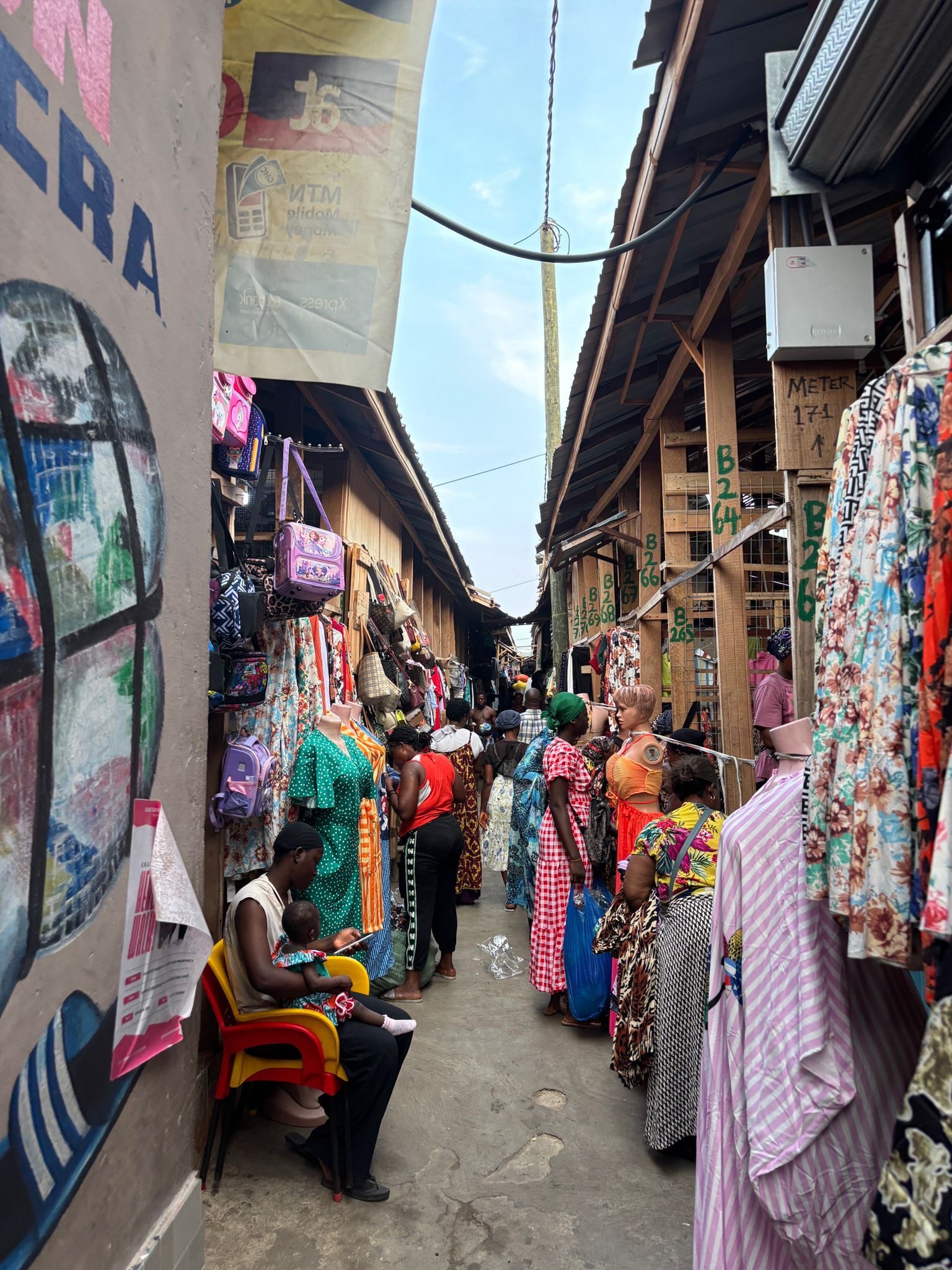
Kantamanto supports more than 26,700 livelihoods, approximately 66% of whom are women. The market comprises around 8,500 stalls, with roughly 86% dedicated to resale and repair, and a further 10% focused on tailoring, upcycling, and remanufacturing (figures sourced from The Or Foundation’s market analysis). It is much more than a marketplace; it is a functioning ecosystem.
The scale is difficult to articulate without being there. The density of activity, the sheer volume of material and the constant movement of goods and people create an environment that is, at times, overwhelming. But it is also highly instructive.
What becomes immediately clear is the physical reality of the scale of global fashion production. The often-quoted figure of 100–150 billion garments produced annually stops being abstract, it is visible, tangible, and concentrated within this single market.
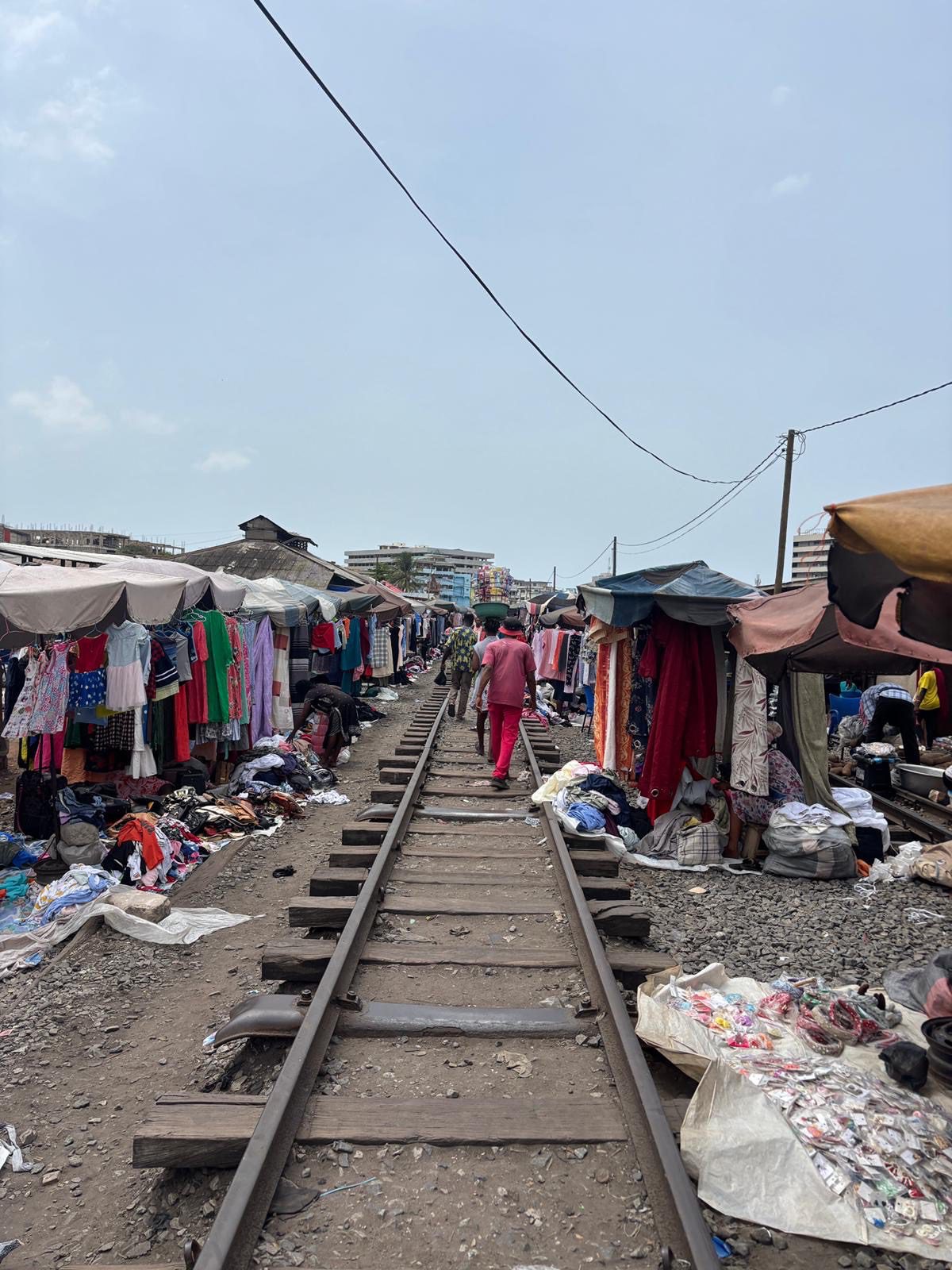
Clothing, footwear, accessories and every category of discarded consumer goods is present. It reinforces just how normalised disposal has become.
At the same time, the market challenges many of the prevailing narratives. There is no sense of passivity. No dependency. Every individual encountered was actively engaged in repairing, sorting, transporting, or selling. This is a working market, driven by necessity, resilience and entrepreneurial instinct.
One of the most important takeaways from the visit is the disconnect in how “waste” is defined.
In the UK and EU, exported clothing is often reduced to a binary: reusable or waste. The reality on the ground is far more complex.
Garments that would be considered perfectly wearable in the UK are often rejected, not because they are damaged, but because they are not suitable. That might be due to:
- Style and cultural relevance
- Fit and sizing
- Fabric weight in relation to climate
- Design features, such as deliberately faded or distressed finishes
In this context, waste is not just about condition. It is about time, labour, money, and space. A garment that cannot be sold is a loss not just of product, but of investment.
This is where the narrative often falls down. Labelling exports as “waste” based on first world interpretation is reductive. It confuses personal preference with material failure and ignores the reality of how these markets operate.
It also calls into question widely quoted figures suggesting that up to 40% of all imported material is waste. That does not reflect what is happening on the ground.
When you account for reuse, repair, adaptation, and resale, the figure is significantly lower, perhaps closer to 2–5%, in line with local industry estimates. But even at that much lower figure, there is still considerable waste.
In many cases, this is not simply a question of material condition, but of how that material is sorted, described, and ultimately exported in the first place. Despite UK material being viewed as relatively high quality, there are clear inconsistencies in export standards.
Bales are expected to be labelled with:
- Exporter details and postcode
- Country of origin
- Weight
- Product category
In practice, this is not consistently enforced. This creates a number of systemic problems:
- Export standards are not being adhered to
- Limited traceability of exporters
- Heavy reliance on intermediaries for accuracy
- No recourse when goods fail to meet expectations
Ultimately, the risk sits with the retailer in the Kantamanto market.
Additionally there is also the issue of education and language barriers that put the retailers at a disadvantage as many of them do not read or write English. The pricing structure across the supply chain amplifies this risk.
Typical pricing observed (childrenswear, one of the highest value categories):
- UK export price: $110–$120 per bale (USD is the preferred currency)
- Landed cost in Ghana: $160–$180
- Retail purchase price: 7,000–15,000 GHS ($630– $1,350 approx. depending on exchange rates)
At each stage, UK exporter, Ghanaian importer, Ghanaian wholesaler adds margin. By the time the bale reaches the retailer, the cost has increased significantly.
A standard 55kg bale of children’s clothing may contain around 165 garments (at 3 items per kg). At a midpoint price of 11,000 GHS, each item needs to sell at approximately 66–67 GHS ($5.89 – $5.98) just to break even.
That is before accounting for:
- Unsellable items (at desired price point)
- Variability in quality
- Fluctuating demand
This creates significant pressure at the retail end, where margins are tight and risk is high.
The system is clearly weighted upstream, with those closest to the end consumer carrying the greatest exposure.
Retailers are heavily reliant on intermediaries, importers and wholesalers not just for supply, but for information.
This creates a clear imbalance:
- Bales are often purchased without full visibility
- Descriptions do not always match contents
- Pricing is dictated by those controlling access
In practical terms, the market is not operating on fully transparent or equitable terms. Control sits with those who manage supply, not those who depend on it.
The work of The Or Foundation is an important part of the wider picture.
Their focus is on environmental justice and systemic change, rather than purely waste management. Their work includes:
- Supporting waste collection and removal
- Providing financial support to traders
- Delivering skills programmes, particularly for women working as head-load carriers
- Conducting research and advocacy around EPR
Their “Stop Waste Colonialism” campaign is pushing for:
- Globally accountable EPR
- Greater transparency on production volumes
- Recognition of reuse markets within circular systems
While some of their framing differs from industry perspectives, their work brings valuable, on the ground insight and reinforces the need to include the impact on receiving markets in policy development.
This visit highlights several immediate priorities:
- Export regulation: The current system allows poor quality and mislabelled material to enter the market unchecked.
- Traceability and accountability: Exporters must be identifiable and accountable for what they ship.
- Understanding market complexity: Simplistic “waste export” narratives risk leading to poorly informed policy.
- Rebalancing risk: Retailers are currently carrying disproportionate financial exposure.
- Meaningful collaboration: Policy must reflect the realities of global reuse markets, not assumptions.
More than anything the visit highlighted that policy is key to enabling system change. In the UK the long delay on a decision on EPR is having damaging knock-on effects throughout the reuse and recycling industry. In the EU, the current disparate approach is also a big concern.
The impacts of the fashion industry do not stop at national borders, and neither should responsibility. Without financial mechanisms that support the full reverse supply chain, including reuse markets, we risk formalising waste displacement under the banner of sustainability.
There is value in that ‘waste’. Value for manufacturers and brands as well as for thriving markets such as Kantamanto. But that value will only be realised by faster, more co-ordinated legislation. Legislation that raises funds for recycling infrastructure globally, that ensures all products where possible recycled and, again where possible, are made with recycled material.
Either EPR is used to reset the economics of fashion, or it becomes another mechanism that allows the system to continue largely unchanged.
Please note: UKFT’s trip was funded by The Or Foundation but our report is based on our independent view.
This is a complex issue with wide-ranging impacts and implications across the global fashion and textiles supply chain. The visit was intended as an awareness and intelligence-gathering exercise to help inform our position on potential policy approaches and solutions. While we are unable to respond to all media enquiries, specific press enquiries can be directed to news@ukft.org