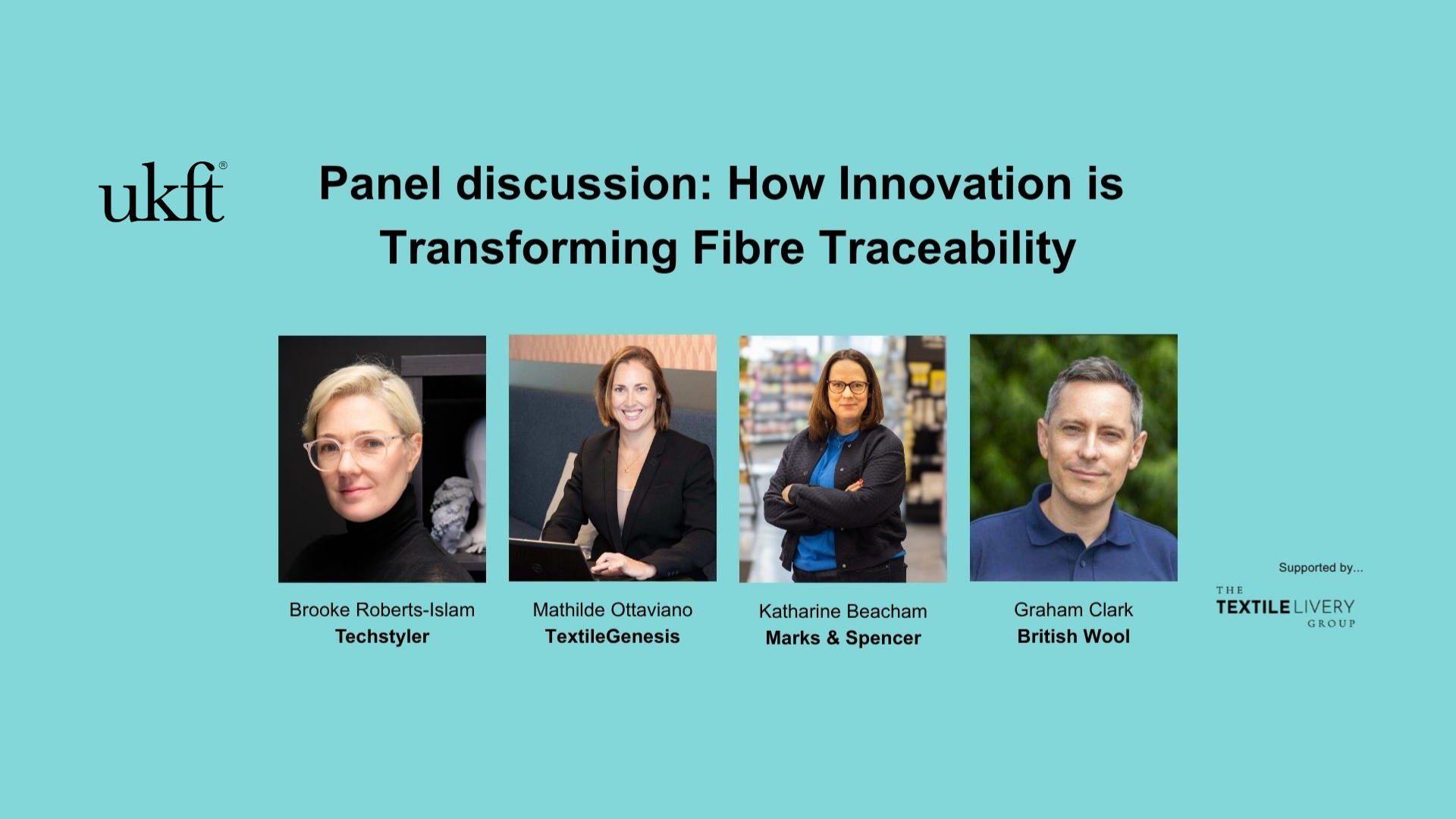
This topic will be explored during the panel discussion, ‘How innovation is transforming fibre traceability’, at UKFT’s Sustainability Conference 2026: Progress in Practice, taking place on Wednesday 23 September at Drapers’ Hall, London.
Bringing together perspectives from natural fibre production, digital traceability and retail, the session will examine how innovation is helping businesses follow fibres through complex global value chains and turn supply chain data into practical insight.
Building trust through traceability
Understanding where fibres come from, how they are processed and where they travel is essential to supporting responsible sourcing and substantiating material claims.
However, fashion and textile supply chains often involve multiple producers, processors, manufacturers and certification systems. Connecting information across these stages remains a significant challenge.
New technologies and collaborative approaches are helping businesses create stronger digital chains of custody, improve the quality of supply chain data and establish greater confidence in the information attached to materials and products.
The panel will consider what credible traceability looks like in practice, how technology can support different types of fibres and supply chains, and what is needed to implement traceability at scale.
Meet the expert panel
The discussion will be moderated by Brooke Roberts-Islam, a sustainability and technology journalist, author, broadcaster and founder of Techstyler. Brooke advises fashion and textile businesses on sustainability, innovation and responsible growth. A Senior Contributor at Forbes and co-author of The GANNI Playbook, she translates complex developments in materials, circularity, supply chains, manufacturing and climate impact into practical insight for brands and suppliers.
Brooke's Techstyler clients include manufacturers in Europe and Asia and brands across the UK and Europe. Drawing on experience spanning science, design, production, media and consultancy, Brooke helps the industry understand how sustainable innovations can be applied in practice.
Techstyler provides sustainability, strategy and communications consultancy for the fashion and textile industries.
Joining Brooke are experts working across fibre sourcing, digital traceability and responsible retail:
- Graham Clark is Marketing Director at British Wool, the farmer-owned organisation representing around 30,000 sheep farmers across the UK. He leads British Wool’s marketing, communications and market development activities, working with manufacturers, brands and retailers around the world to increase demand for British wool. Graham has spent much of his career connecting farmers with global markets and promoting wool as a natural, renewable fibre. He is particularly interested in traceability, sustainability and the creation of new commercial opportunities for British wool across interiors, bedding, fashion and technical applications. Since 1950, British Wool has collected, graded and sold wool on behalf of UK sheep farmers. Today, the organisation works with manufacturers, brands, retailers and researchers worldwide to grow demand for British wool while supporting the farming communities behind it.
- Mathilde Ottaviano is Senior Business Development Manager at TextileGenesis where she develops programmes that support fashion and luxury brands, international ESG material standards and innovative fibre producers in building more transparent, trusted and resilient supply chains. With a background spanning sustainability, responsible sourcing, procurement and international business development, Mathilde brings a detailed understanding of the challenges facing global value chains. Before joining TextileGenesis, she held sustainability and sourcing roles across the fashion and consulting sectors. Mathilde is focused on using innovation and collaboration to strengthen supply chain transparency, support responsible business practices and enable credible product and fibre traceability at scale. TextileGenesis is a traceability platform for the fashion and textile industry, providing end-to-end supply chain visibility for sustainable, preferred and certified fibres. Founded in 2018, its software helps organisations strengthen their digital chain of custody and verify material claims. More than 400 global brands use TextileGenesis, with over 24,000 supply chain participants onboarded and more than five billion units tracked through the platform.
- Katharine Beacham is Head of Raw Materials, Sustainability, Packaging and Responsible Sourcing in Fashion & Home, Marks & Spencer. Her work focuses on sourcing materials with care, improving traceability and embedding circular design principles. This includes Another Life, M&S’s approach to extending the useful life of products through resale, recycling, repair and reuse. Katharine’s work supports Plan A, M&S’s environmental, social and governance strategy, and the retailer’s ambition to become a net zero business across its operations and entire value chain by 2040. M&S is a British retailer serving 32 million customers annually across the UK and 32 international markets. For more than 140 years, the business has focused on providing quality products at trusted value. Its Plan A strategy underpins its commitment to sourcing and making products with care while supporting sustainable, profitable growth.
From fibre data to practical decisions
Together, the panel will explore how innovation can help businesses build a clearer picture of a fibre’s journey, from its point of origin through processing and manufacturing to the finished product.
The discussion will consider how digital platforms can connect information from different supply chain partners, how fibre producers and certification systems can contribute reliable data, and how brands and retailers can use that information to support sourcing and product decisions.
It will also examine the practical challenges involved, including data quality, interoperability, supplier engagement and the need to make traceability accessible across different business sizes and supply chain models.
Central to the conversation will be a key question: how can the industry move from collecting more supply chain data to using trusted information that supports accountability, responsible sourcing and long-term value?
UKFT’s Sustainability Conference 2026
UKFT’s Sustainability Conference 2026: Progress in Practice will explore how innovation is driving measurable change across the UK fashion and textile supply chain.
Taking place on Wednesday 23 September, from 9am to 6pm at Drapers Hall, London, the conference will showcase developments across bio-based materials, low-impact dyes and finishes, textile reuse and recycling, data-driven circularity, and traceability and transparency.
For businesses working to improve supply chain visibility, meet evolving regulatory expectations and substantiate material claims, this session will offer practical insight into the technologies, partnerships and approaches shaping the next stage of fibre traceability.
Find out more about UKFT’s Sustainability Conference 2026: Progress in Practice at the link below.

.png)