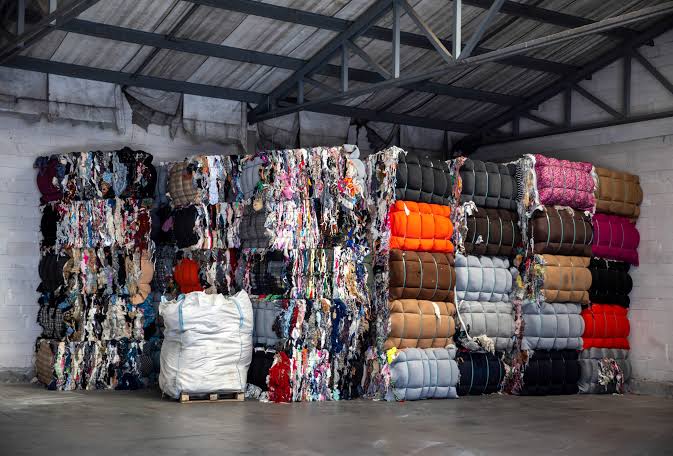
What could a textile recycling hub really look like in the UK?
UKFT has launched a new report that outlines the social and economic impact of a model which would be anchored by three Automatic Textile Sorting Plants (ATSPs) and a chemical recycling plant.
The report, developed by Oxford Economics and commissioned by the UK Fashion and Textile Association (UKFT), sets out the economic and environmental case for scaling up textile recycling infrastructure in the UK. It presents a phased plan to build a national recycling hub over the next decade.
At full capacity, the hub would divert nearly 150,000 tonnes of textile waste from landfill and incineration each year. Of this, 50,000 tonnes would be chemically recycled into new clothing fibres, while the remainder would be directed into alternative recycling or reuse pathways.
This redirection of waste would result in substantial cost savings. Currently, around one million tonnes of used textiles are discarded annually in the UK, with roughly a third ending up in landfill, incinerated or exported. These disposal methods carry a significant economic burden, costing the UK around £200 million each year. The proposed recycling hub could help reduce this cost by more than £24 million annually in avoided landfill and incineration gate fees when operational.
The proposal also offers a clear economic return. The construction and fit-out of the facilities over a four-year period could support 620 job years and add £46 million in Gross Value Added (GVA) to the UK economy. Once operational, the hub could support 720 jobs across the wider economy and contribute around £53 million to GDP every year.
The report suggests that the hub could serve as an anchor for regional textile circularity, with the East Midlands, North West and South West identified as host regions for the ATSPs. The East Midlands, which would also house the chemical recycling plant, stands to benefit most in terms of regional economic growth.
Advanced technology would be central to the operation of the hub. The ATSPs would use automated systems to sort textile waste by fibre type and quality, enabling more efficient recycling. The chemical recycling facility would support closed-loop recycling, particularly of polyester and potentially other synthetic fibres.
The report forms part of the Circular Fashion Innovation Network (CFIN), an industry-led initiative led by UKFT and the British Fashion Council (BFC), in partnership with UK Research and Innovation (UKRI). CFIN focuses on six core areas including recycling infrastructure, sustainable manufacturing and green growth. It runs alongside the ACT UK project, also led by UKFT, which aims to establish a practical blueprint for an ATSP in the UK.
Download the full report and supporting data at the link below: