
UK textile innovation showcased at Techtextil and Texprocess (April 2026)
09/04/2026
UKFT is proud to support a dynamic group of UK exhibitors at Techtextil the leading international event for technical textiles, taking place in Frankfurt am Main from 21–24 April 2026.
The UK exhibitors at Techtextil (April 2026)
Discover British Technical Textiles at Techtextil
A total of 42 UK companies will present their latest innovations across advanced materials, performance fabrics and manufacturing technologies, highlighting the breadth and capability of the UK’s technical textiles sector. Exhibitors include W. Ball & Son Limited (Baltex), Bowmer Bond Narrow Fabrics, British Millerain, Carrington Textiles, CORDURA® Advanced Fabrics, Francis Dinsmore, Don & Low Ltd, Fibre Extrusion Technology, Heathcoat Fabrics, James Heal / PPT Group UK, Makefast, Nonwovenn, PIL Membranes, Pincroft Dyeing & Printing Co., SDC Enterprises, Stretchline, Supercrease, TBA Protective Technologies, THS Industrial Textiles, Toray Textiles Europe and Waxman Speciality Products.
Running alongside Techtextil, Texprocess will feature a further eight UK companies demonstrating expertise in textile and apparel processing technologies. Participating companies include Ardmel Automation, CLR Code (Coloro), Coats Group, Digitisingmart Europe, MMS UK, Solent Sewing Machines, Verivide and Wilcom Europe.
The UK presence will be coordinated by UK Fashion & Textile Association (UKFT), which will promote the sector from Hall 2.1, Stand F31, providing a focal point for international buyers, partners and industry stakeholders to engage with UK innovation.
UKFT’s promotion of the UK group at Techtextil and Texprocess has been made possible through the generous support of the Department for Business and Trade and The Worshipful Company of Clothworkers.
Together, the UK exhibitors represent a forward-looking industry focused on performance, sustainability and advanced manufacturing, reinforcing the UK’s position as a global partner in technical textiles and textile technology.
DISCOVER UK TECHNICAL TEXTILES HERE
The UK has long been recognised as a centre of excellence in textile innovation, and today its technical textiles sector reflects both deep heritage and advanced scientific capability. Across the country, manufacturers, material specialists, machinery developers and testing laboratories contribute to a highly diverse ecosystem that supports industries ranging from aerospace and defence to healthcare, construction, filtration, automotive and advanced composites. The breadth of activity demonstrates how technical textiles in the UK extend far beyond conventional fabrics, encompassing engineered materials, specialised fibres, precision components, coatings, membranes and advanced processing technologies.
A defining strength of the UK sectoris its wide range of application areas. British companies develop textiles used in demanding environments where performance, durability and safety are essential. In aerospace and defence, engineered fabrics provide reinforcement, ballistic protection, fire resistance and lightweight structural support. Automotive manufacturers rely on advanced textiles for components such as airbags, seatbelts, reinforcement structures and interior systems. In the medical and healthcare sectors, specialised fabrics contribute to wound care, patient support systems, filtration, drug delivery and protective clothing. Technical textiles also support geotechnical engineering, construction membranes, filtration systems,
energy technologies and industrial processing. This broad spectrum of applications highlights the adaptability of textile engineering as a materials platform capable of delivering tailored performance solutions.
Underlying these applications is a highly varied product landscape. UK companies produce woven, knitted and nonwoven fabrics, as well as advanced spacer materials, composite reinforcements and engineered narrow fabrics such as webbing and elastics. Specialist coatings, laminates and membranes add functional characteristics including waterproofness, breathability, chemical resistance and thermal protection. High-performance fibres such as aramid, carbon, PEEK (polyetheretherketone), PPS (polyphenylene sulfide) and high- modulus polyethylene are processed alongside natural fibres and recycled materials to achieve specific mechanical, thermal or environmental properties. Complementing the materials themselves are enabling technologies such as fibre extrusion systems, lamination equipment, yarn splicing systems, testing instrumentation and intelligent inspection technologies that ensure consistent quality and efficiency across production.
Another notable feature of the UK technical textiles sector is its strong geographical distribution. Expertise is spread across England, Scotland, Wales and Northern Ireland, forming regional clusters that reflect both historic textile regions and modern centres of advanced manufacturing. Northern England remains a hub for fibre development, weaving, finishing and textile machinery. The Midlands and East of England host specialists in membranes, coatings, narrow fabrics and technical components. Scotland contributes significant capability in nonwoven manufacturing and geotextile development, while Wales and Northern Ireland provide expertise in advanced yarn technologies, finishing processes and high-performance materials. This nationwide network creates a collaborative environment which manufacturers, technology developers, universities and research centres interact closely to accelerate innovation.
Innovation remains central to the UK’s global reputation in technical textiles. Companies invest heavily in research and development to create new fibre systems, engineered structures and functional finishes that respond to emerging industrial challenges. Advances include three-dimensional textile architectures for lightweight composites, activated carbon fabrics for filtration and protective applications, precision monofilaments for industrial fabrics, and advanced inspection systems that use machine learning to detect defects in real time. Many companies also operate development laboratories and pilot production facilities that allow customers to test concepts, prototype new materials and refine processes before scaling to full production.
Sustainability is an increasingly important driver across the sector. UK manufacturers are investing in recycled fibres, biodegradable polymers and circular material strategies, while process innovations aim to reduce energy consumption, water usage and waste during manufacturing. Advanced finishing technologies, heat recovery systems and improved resource management contribute to lower environmental impact. At the same time, technical textiles themselves often can contribute to environmental goals in downstream industries by extending product lifetimes, reducing material weight, improving energy efficiency or supporting environmental protection through filtration and containment systems.
Equally important is the sector’s strong culture of collaboration and compliance. Many UK companies operate under internationally recognised standards such as ISO quality management systems and OEKO-TEX® certification, ensuring that materials meet strict regulatory and safety requirements. Testing and verification play a crucial role, with specialised laboratories providing reliable measurement of colour fastness, durability, fire resistance and other critical properties. This commitment to compliance ensures that UK-developed materials perform reliably in highly regulated industries including aerospace, defence, healthcare and infrastructure.
Finally, a hallmark of the UK technical textiles sector is its emphasis on partnership and bespoke development. Rather than supplying standard materials alone, many manufacturers work closely with customers to engineer application- specific solutions. This collaborative approach spans the entire product lifecycle, from fibre selection and fabric construction through to coating, lamination, testing and final integration into complex systems. By combining deep technical expertise with flexible manufacturing capability, UK companies help clients transform performance requirements into fully realised textile solutions.
Together, these capabilities illustrate the scale and diversity of the UK technical textiles industry. With strengths spanning materials science, advanced manufacturing, lower impact production and collaborative innovation, the UK continues to play a significant role in developing high- performance textile solutions for some of the world’s most demanding applications.

Baltex (Techtextil April 2026) Defence applications
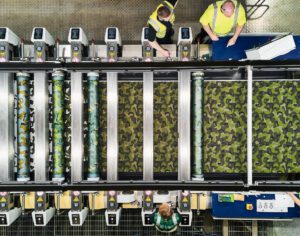
Pincroft (Techtextil April 2026)
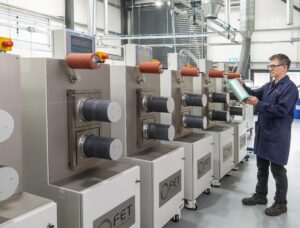
Fibre Extrusion Technology (FET) Techtextil April 2026
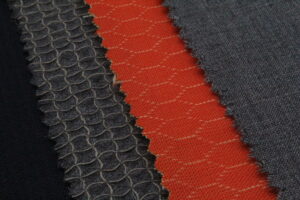
British Millerain (Techtextil April 2026) Flame-retardant, antistatic and PFC -Free DWR finishes
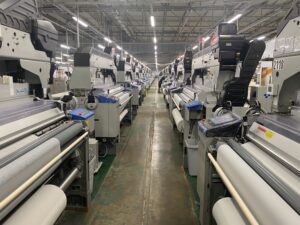
Toray Textiles Europe (Techtextil April 2026)

Carrington (Techtextil April 2026)
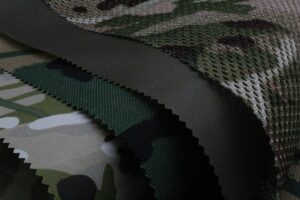
British Millerain (Techtextil April 2026) Breatheable, non-breatheable and silicone coatings for defence

Baltex (Techtextil April 2026) Medical applications

Baltex (Techtextil April 2026) Aerospace applications